
[vc_row full_width=”stretch_row_content”][vc_column css=”.vc_custom_1510708260195{margin-top: 0px !important;}”]
 “The nursery is the natural extension up from the family, not the natural extension down from school”
About IPS Nursery
IPS has been responsible for the care and education of young children for over 60 years. We are committed to continual self-evaluation, and compliance with modern standards of child-care provision. We welcome children from all nations and adopt and support the values of tolerance, cooperation, respect, and the diversity of dents.
Principles of Practice
Working with babies and children is a complex, challenging and demanding task. To enable us to carry out our responsibilities we acknowledge a clear set of guiding principles. At IPS we believe:
- Parents and families are central to the well-being of the child.
- Relationships with other people (both adults and children) are of crucial importance in a child’s life.
- A relationship with a key person at home and in the setting is essential to a young child’s well-being.
- Caring adults count more than resources and equipment.
- Babies and young children are social beings: they are competent learners from birth.
- Learning is a shared process and children learn most effectively when, with the support of a knowledgeable an trusted adult, they are actively involved and interested.
- In the ‘holistic’ nature of development and learning.
- Children learn when they are given appropriate responsibility, allowed to make errors, decisions and choices, and respected as autonomous and competent learners.
- Children learn by doing rather than by being told.
- That a child’s individuality, efforts and achievements should be recognised and valued.
- Schedules and routines must flow with the child’s needs.
- Young children are vulnerable. They learn to be independent by having someone they can depend upon.
Learning is a shared process and children learn most effectively when, with the support of a knowledgeable an trusted adult, they are actively involved and interested.
Learning & Development
We plan for, focus on, and facilitate development with respect to four aspects.
Our focus is the whole child. We steer away from distinct subject headings, preferring to focus on overarching features, which celebrate the skill and competence of young children.

A Strong Child

A Skilful Communicator

A Competent Learner

A Healthy Child
The importance of play
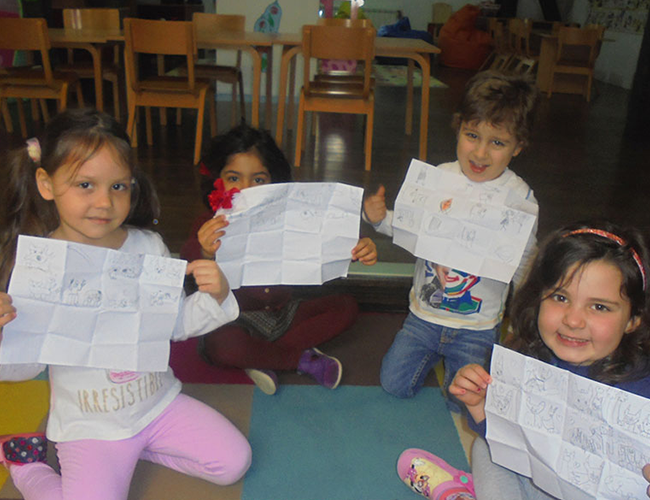
Young children learn through play, and can not be rushed through an activity – children need choice of what to play with, they may need to be uninterrupted and have time to play alone, or with others in a safe and supervised environment. A skilled early childhood practitioner provides plenty of opportunity for play and structures it only by providing different resources, which can be used in a range of ways. With responsive, observant teachers, who guide, and gently challenge children we can build up a holistic picture of your child’s preferences and responses to the world around them. This then allows us to structure play that fits with a child’s passion as well as tentatively plan for learning outcomes. Essentially, children point the direction and we provide the platform.

Focused activities
As well as self-initiated and structured play, teachers plan for a host of sensory activities through which children assimilate new experiences and understandings about the exciting and wondrous world around them. These focused activities are planned and implemented via a variety of sources including the teachers’ own experiences, ideas from colleagues and good practice from practitioners around the world. IPS uses the ‘Early Years Foundation Stage’ curriculum as it’s educational framework for all learning and guided activities for our Nursery and Kindergarten children.
The EYFS curriculum provides a firm foundation across a range of both academic and social skills for children, to prepare them fully as they move up through the Nursery into Primary Years.
Concerns over child development
For some children, development may be at risk because of difficulties with communication and interaction, cognition and learning, behavioural, emotional and social development or sensory and physical development.
Our teachers monitor each child’s development carefully against a set of developmental criteria and will alert parents to any concerns they have observed.
Of course, one must be careful not to make rash judgments. Children learn at different rates and progress through stages of development can vary widely. We will point out concerns to parents and discuss possible ways to help. Where we are unable to assist, the school may suggest intervention from outside agencies such as an educational psychologist, speech therapist or pediatrician for example.


